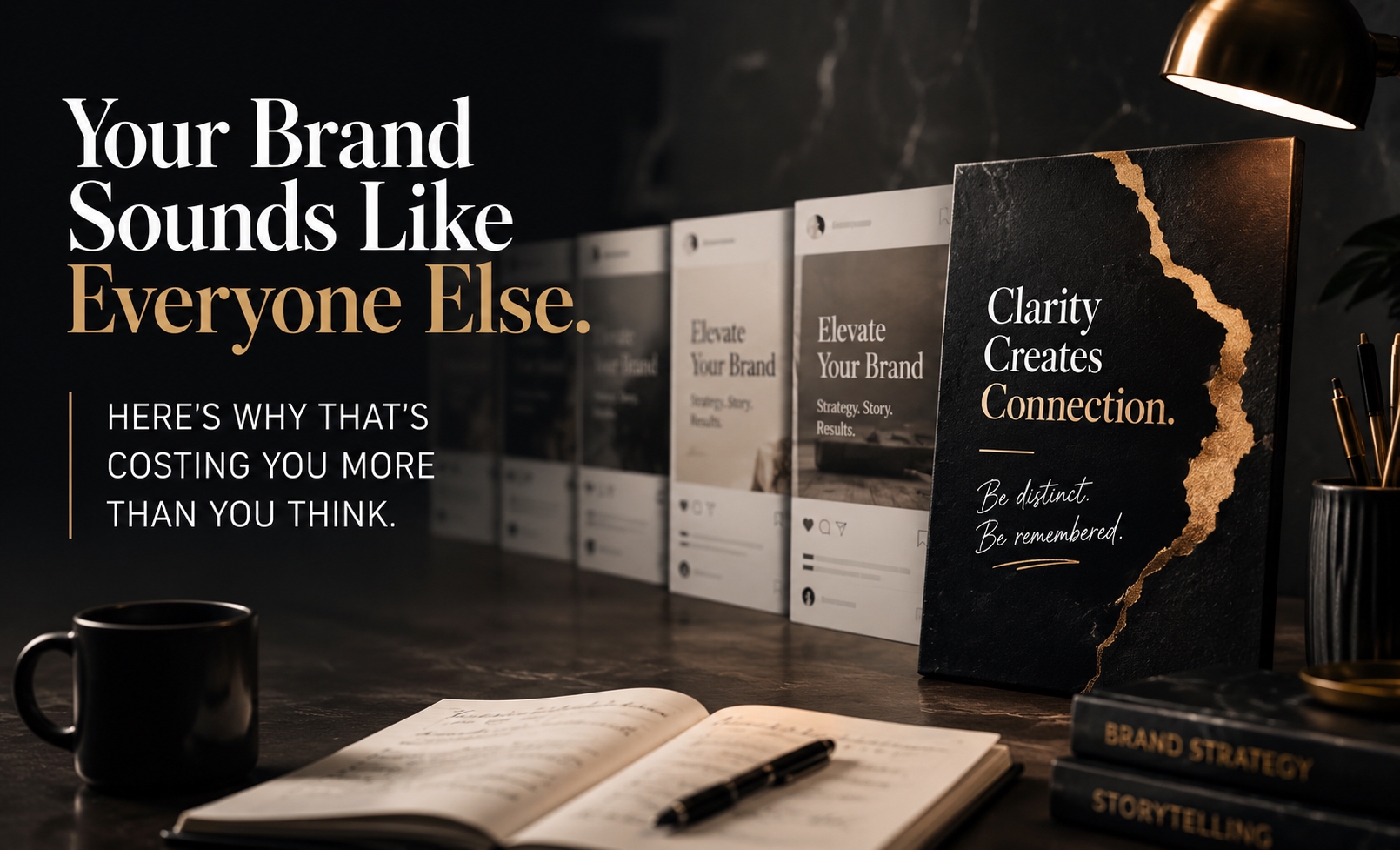
Your Brand Sounds Like Everyone Else. Here's Why That's Costing You More Than You Think.
There's a moment most brand founders don't notice until it's too late.
It's the moment their brand stopped sounding like them.
Somewhere between the first viral post and the third hired content manager, the voice changed. The edges got smoothed out. The opinions got hedged. The personality got replaced by a template — because templates feel safe, and safety feels professional.
But your audience noticed.
They didn't say anything. They just started scrolling past.
The Homogenization Problem
Open Instagram right now and look at ten brands in your industry.
Count how many use the same caption structure. The same emojis. The same "motivational Monday" format. The same call-to-action that ends with a question nobody actually answers.
This is what happens when strategy replaces story.
When brands chase what's working for others instead of what's true for them, they don't get results — they get noise. And the internet already has enough noise.
The brands that cut through aren't the ones who post more. They're the ones who sound like themselves, consistently, even when it's uncomfortable.
The Root of the Problem
Most content strategies are built backward.
They start with platforms. Then formats. Then frequency. Then aesthetics. And somewhere at the end — almost as an afterthought — they ask: what do we actually want to say?
Story is supposed to come first.
When you know what you actually believe, what you've lived, what you've seen — then the platform choice, the format, the caption structure all become obvious. They exist to serve the story. Not the other way around.
The brands that lose their voice do so because they skip this step. They outsource the strategy before the story is clear. And then the agency writes in a voice that sounds like an agency — because they have nothing else to work with.
What a Real Brand Voice Looks Like
It has friction. It has a point of view. It says things that not everyone will agree with.
It sounds like a person who has thought carefully about something and arrived at a real conclusion — not a committee-approved message designed to offend no one.
This is harder than it sounds. It requires the founder to be visible. To have convictions. To be willing to say something that matters even if it means some people won't buy.
But the brands that do this — that build around a genuine human voice at the center — build something that can't be replicated. Because no algorithm, no competitor, no market shift can copy what's actually yours.
What We Do About It
At Screenwriter601 Story Studio, we start every engagement with a single question that most agencies skip entirely:
What is the true story of this brand?
Not the mission statement. Not the elevator pitch. The real story — the founder's actual perspective, the tension the brand exists to resolve, the specific way this company sees the world differently than everyone else.
That's what we build the content from. That's what makes it work.
Because content without story is just noise with good lighting.
If your brand sounds like everyone else, it's not a design problem or a budget problem. It's a story problem.
And that's exactly what we're here to fix.
Screenwriter601 Story Studio is a boutique content and community studio for founder-led brands. We build brand voice, social content, and community strategy for brands that are ready to stop blending in.
Topics
- #BrandVoice
- #ContentStrategy
- #FounderLedBrands
- #Storytelling
- #SocialMediaMarketing
- #ContentMarketing
- #Branding
Community
The Real Reason People Unfollow Brands (It Has Nothing to Do With Your Content)
Most brands blame the algorithm. And the numbers stay flat. Because the algorithm isn't the problem.
3 min read
Content Strategy
Posting More Is Not a Strategy. It's Panic.
At some point, every brand has the same conversation. The content calendar gets doubled. And the numbers stay soft.
3 min read
Your brand does not need another template. It needs a story only it can tell.
Start a Conversation